Greece
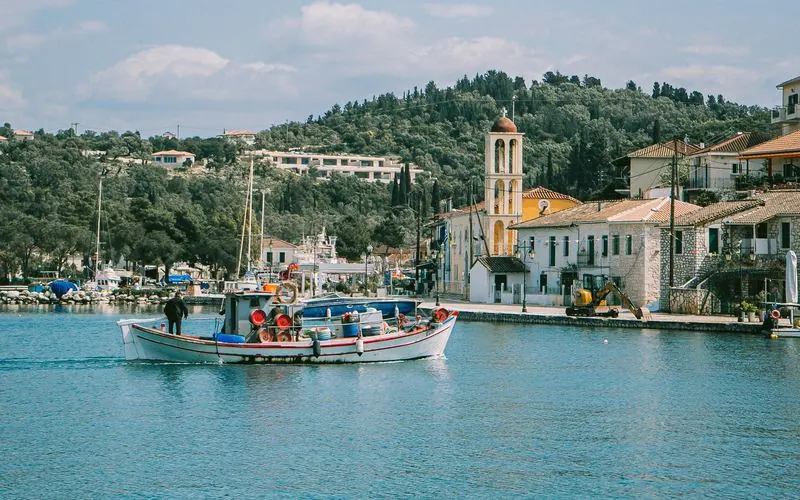
Whitewashed harbor villages, tavernas on the quay, and clear swimming coves, across three very different island groups.
- Best months
- May to October; June and September are the sweet spot
- Sailing
- Gentle in the Ionian and Saronic; strong summer winds in the Cyclades
- Typical trip
- 7 nights in one island group
- Fly into
- Preveza (PVK) or Corfu (CFU) for the Ionian; Athens (ATH) for the Saronic and Cyclades
- Start bases
- Lefkas or Corfu; Athens-area marinas
- Currency
- Euro
Why sail here
Greece is less one destination than several. The Ionian islands on the west coast are green, sheltered and close together. The Saronic islands are an easy hop from Athens. The Cyclades in the Aegean are the whitewashed, windswept islands of the postcards.
What they share is the evening routine: tie up stern-to on a village quay, walk ashore, and eat at a taverna a few steps from the boat. Days are for sailing to the next harbor with a swim stop in a cove along the way.
Picking the right island group for your dates and your group matters more here than almost anywhere else, so the choices below come first.
Highlights
Meganisi and Kalamos
Small Ionian islands near Lefkas with deep, quiet bays, village quays and some of the calmest water in Greece.
Ithaca and Fiskardo
Kioni's horseshoe harbor on Ithaca and the pastel waterfront of Fiskardo on Kefalonia, a short sail apart.
Paxos and Antipaxos
South of Corfu: small harbors at Lakka and Gaios, sea caves along the west cliffs, and Antipaxos's clear water.
Hydra and the Saronic
Car-free Hydra and its stone harbor, plus Poros, Aegina and Spetses, all within a short sail of Athens.
Milos and the Cyclades
Volcanic coastline and sea caves on Milos, and the classic white villages of Paros and Naxos. A windier, more open-water trip.
Quay-side evenings
In most harbors the boat ties up a few steps from the tavernas. Sunset, dinner ashore and a short walk back aboard.
Choices that shape your week
Which island group
The Ionian is the easiest and greenest, with short hops and afternoon breezes. The Saronic suits a short trip from Athens with history ashore. The Cyclades give the most iconic scenery but longer, windier crossings.
When, given the meltemi
In July and August a strong north wind, the meltemi, often blows 20 to 25 knots across the Cyclades. The Ionian sees a much milder afternoon breeze. For the Cyclades, June or September is a better bet.
Village quays or quiet bays
Most nights can be spent on a town quay with tavernas ashore, or at anchor in a bay with nothing but the boat. Quays fill early in high season; most weeks mix both.
Pace
A week in the Ionian can stay at two or three hours of sailing a day. The Cyclades cover more distance, so plan for fewer stops or more time on the water.
Places to go, things to do
Swim and snorkel
- Papanikolis sea cave, Meganisi
- Kioni and the coves of Ithaca
- Antipaxos's bays
- Sea caves of Milos
- Port Leone bay, Kalamos
Harbors and anchorages
- Lefkas
- Kalamos
- Vathi, Meganisi
- Kioni, Ithaca
- Fiskardo, Kefalonia
- Vassiliki and Sivota, Lefkada
- Gaios and Lakka, Paxos
- Hydra and Poros
Ashore
- Taverna dinners on the quay
- Corfu's old town
- Hydra's car-free lanes
- Temple of Poseidon at Cape Sounion, from the Saronic
- White villages of Paros and Naxos
A sample 7-night week
A sample route in the southern Ionian, starting and ending in Lefkas, based on commonly sailed circuits. Weather and your group decide the real one.
- Night 1LefkasBoard in the afternoon, provision, and spend the first evening in town.
- Night 2KalamosOut through the Lefkas channel; tie up at the village quay.
- Night 3Vathi, MeganisiLunch and a swim in a sheltered bay on the way.
- Night 4Kioni, IthacaA horseshoe harbor with clear water for snorkeling.
- Night 5Vassiliki, LefkadaOptional stop in Fiskardo on Kefalonia on the way.
- Night 6Sivota, LefkadaA swim and lunch in a bay before a quiet harbor night.
- Night 7LefkasPast the Papanikolis sea cave and Nydri, back to the marina.
Practical details
Getting there
For the Ionian, Preveza airport (PVK) is about 40 minutes from Lefkas, and Corfu (CFU) serves the northern islands. For the Saronic and Cyclades, Athens (ATH) is close to the main charter marinas. From North America, most routes connect through a European hub or Athens.
Passports and paperwork
Greece is in the Schengen area. Charter companies require a crew list with each guest's passport details ahead of departure, and originals at check-in.
Mooring and fees
Boats usually tie up stern-to on town quays or in marinas. As of April 2026, published guidance puts small-harbor quays at about €5 to €15 a night and popular marinas at €25 to €65, with catamarans often charged 50 to 80% more. Some taverna jetties are free if you eat there.
Weather
The meltemi blows hardest in July and August in the Aegean, including the Cyclades. The Ionian has a lighter northwest breeze on summer afternoons that usually dies down by evening.
Not included in the boat price
Typically fuel, harbor and marina fees, provisioning, meals ashore, flights and transfers. The cost estimator shows each as its own line.
What would a week here cost?
Price a week in Greece line by line, then send us the scenario or start a trip plan your group can vote on.
Questions about Greece
Which part of Greece is best for a first sailing trip?
The Ionian, around Lefkas or Corfu. Distances are short, the water is sheltered, and the summer breeze is moderate. The Saronic, near Athens, is a good second choice.
Should we avoid July and August?
Not everywhere. Those months bring the strongest meltemi to the Cyclades and the biggest crowds everywhere. The Ionian is a reasonable choice in high summer; for the Cyclades, June or September is better.
Can we sail between the Ionian and the Cyclades in one week?
Not practically. They are on opposite sides of mainland Greece. Each group fills a week on its own.
Do we eat out every night?
As often as you like. Most harbors have tavernas on the waterfront, and many groups eat ashore most evenings and have breakfast and lunch aboard.