Guadeloupe & Les Saintes
A French Caribbean island of volcano hikes, rainforest waterfalls and the Cousteau reserve, with the little harbor of Les Saintes a short sail south.
- Best months
- December to May; January to March are the most settled
- Sailing
- Trade-wind passages between islands; some longer legs
- Typical trip
- 7 nights
- Fly into
- Pointe-à-Pitre, Guadeloupe (PTP)
- Start base
- Marina Bas du Fort, Pointe-à-Pitre
- Currency
- Euro
Why sail here
Guadeloupe is France in the Caribbean: French food and bakeries, euros, and a mix of landscapes rare in the region. Basse-Terre, the western wing, is mountainous rainforest with waterfalls and the La Soufrière volcano; the coast around it has reefs and the Cousteau underwater reserve.
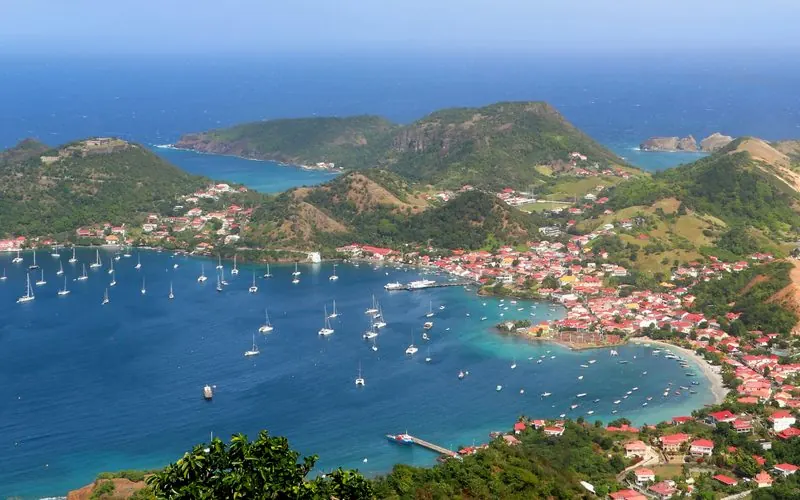
Just offshore are smaller islands with their own character. Les Saintes has a sheltered natural harbor ringed by a small village, beaches and an old fort. Marie-Galante is flat, rural and quiet, with sugarcane fields and long beaches.
Highlights
Les Saintes
A natural harbor at Terre-de-Haut with a small village, beaches and Fort Napoléon above the bay. Easily worth two nights.
Cousteau reserve and Pigeon Islands
A protected underwater reserve off Basse-Terre's west coast, with coral gardens, reef fish and an underwater bronze of Jacques Cousteau.
Marie-Galante
A flat, rural island of sugarcane fields, old windmills and long, quiet beaches.
La Soufrière and the rainforest
A hike up Guadeloupe's active volcano, and waterfalls in the national park. Best done on a shore day.
Dominica
The mountainous, forested island to the south, with hot springs and rivers. A separate country, reached from Portsmouth Bay.
Petite Terre
Two small nature-reserve islands off Guadeloupe's east end. Moorings must be booked in advance.
Choices that shape your week
Guadeloupe only, or add Dominica
Staying in Guadeloupe's islands (Les Saintes, Marie-Galante, Basse-Terre's coast) keeps legs shorter and needs no border crossings. Adding Dominica brings a very different, wilder island, at the cost of customs and a longer passage back.
How many nights in Les Saintes
One night is the minimum; two give time for the fort, the beaches and a walk around the island without rushing.
A day ashore
The volcano hike and the waterfalls are inland. Building in a shore day, with a taxi or rental car, is the way to see them.
When to go
December to May is the dry season, and January to March is the most settled. Summer is hotter, more humid and rainier, with lighter, less steady wind, and falls in hurricane season.
Places to go, things to do
Swim and snorkel
- Pigeon Islands, Cousteau reserve
- Pain de Sucre, Les Saintes
- Marie-Galante's reefs and beaches
- Petite Terre (booked moorings)
- Îlet du Gosier
Anchorages and harbors
- Anse Canot, Marie-Galante
- Terre-de-Haut, Les Saintes
- Portsmouth Bay, Dominica
- Off the Pigeon Islands
- Îlet du Gosier
- Marina Bas du Fort
Ashore
- Fort Napoléon, Les Saintes
- La Soufrière volcano hike
- Waterfalls in the Guadeloupe national park
- Dominica's rainforest and hot springs
- Pointe-à-Pitre market
A sample 7-night week
A sample route from Pointe-à-Pitre, including a stop in Dominica, based on commonly sailed circuits. Weather and your group decide the real one.
- Night 1Marie-GalanteAbout 15 nautical miles south to Anse Canot for a first night at anchor.
- Night 2Portsmouth Bay, DominicaAbout 20 nautical miles to Dominica.
- Night 3DominicaClear customs and spend a day ashore: rivers, rainforest and hot springs.
- Night 4Pigeon IslandsThe week's longest leg, about 35 nautical miles, to the Cousteau reserve.
- Night 5Les SaintesAbout 20 nautical miles south to Terre-de-Haut.
- Night 6Les SaintesA second night for the fort, beaches and snorkeling at Pain de Sucre.
- Night 7Îlet du GosierBack toward Pointe-à-Pitre for a last night at anchor, a short sail from the marina.
Practical details
Getting there
Pointe-à-Pitre International Airport (PTP) is about 30 minutes by taxi from the marina, with direct flights from some eastern US cities and connections through nearby islands.
Passports and customs
Guadeloupe is part of France, uses the euro, and French is the main language. Customs clearance is required when arriving from or leaving for another country, such as Dominica; Les Saintes, Marie-Galante and Petite Terre need none. The captain handles it; everyone needs a passport.
Moorings
Moorings are available at Les Saintes, Petite Terre and Portsmouth on Dominica; Petite Terre's must be booked ahead. Elsewhere boats anchor.
Weather
A steady northeasterly trade wind blows from January to April. Summer wind is lighter and less regular, with more rain. Hurricane season runs June through November.
Not included in the boat price
Typically fuel, moorings, clearance fees, provisioning, meals ashore, flights and transfers. The cost estimator shows each as its own line.
What would a week here cost?
Price a week in Guadeloupe and Les Saintes line by line, then send us the scenario or start a trip plan your group can vote on.
Questions about Guadeloupe and Les Saintes
Do we need to speak French?
No, though a few words help. English is understood in tourist areas and marinas, and the captain handles the official paperwork.
Is Dominica worth including?
For groups who like hiking, rivers and rainforest, yes. It adds a border crossing and a long passage back, so groups who want shorter days often stay within Guadeloupe's islands.
Can we hike the volcano during the trip?
Yes, with a shore day. La Soufrière and the waterfalls are inland on Basse-Terre, reached by taxi or rental car from a nearby anchorage or marina.
When is the best time to go?
January to March has the most settled weather; December to May is the dry season overall. Summer is hotter and wetter and falls within hurricane season.